 iVIGA Faucet Online Shop

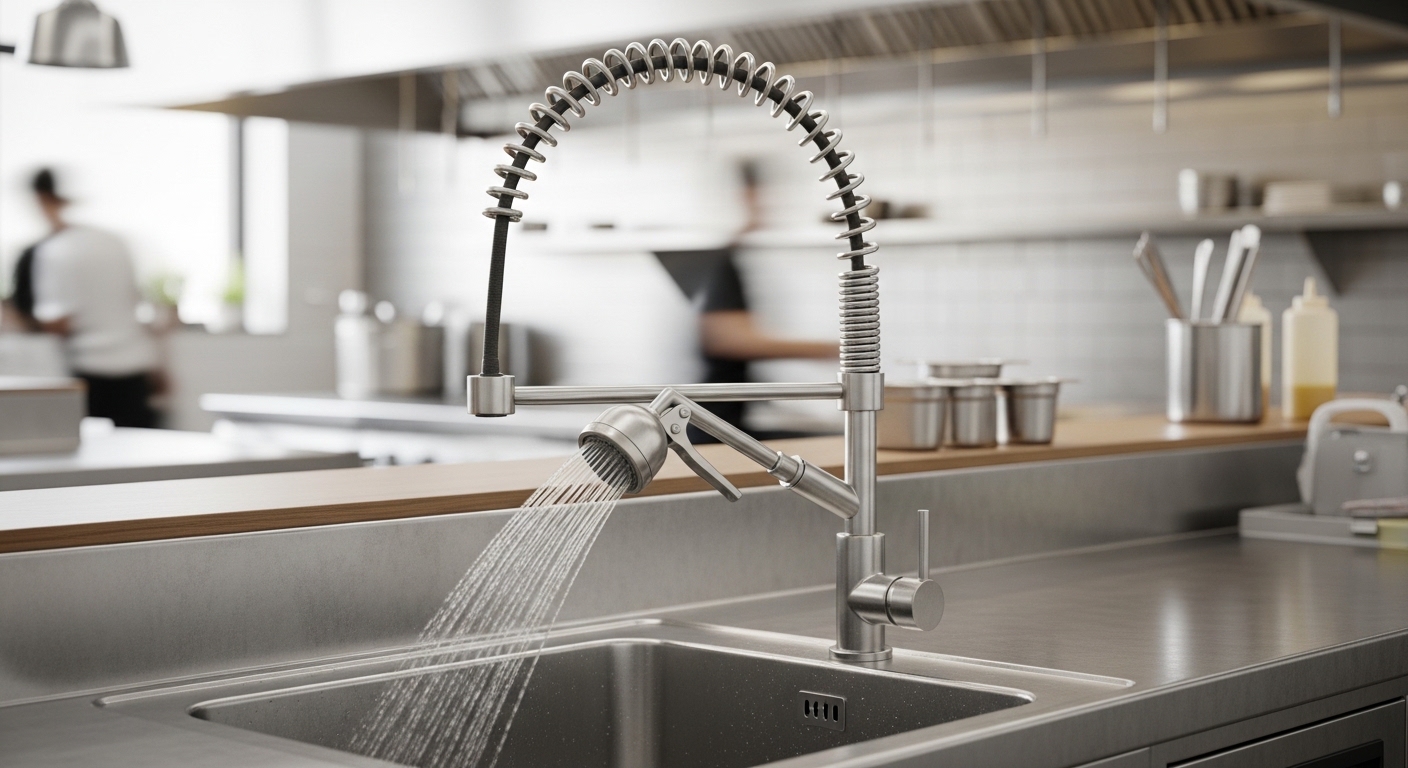
If you’ve been searching “commercial kitchen tap near me” because a faucet died in the middle of a dinner rush, you already know the problem: the hardware store down the road stocks residential faucets, and the one or two “commercial-style” models they carry are usually decorative copies that won’t take eight hours of hard daily use. A true commercial kitchen tap is a different animal — taller, tougher, built around a high-arc pre-rinse spout, a heavy-duty cartridge, and fittings that meet plumbing and food-safety codes. This guide explains exactly what to look for, where “near me” actually helps versus where it hurts, and how to choose a tap that won’t fail you again next month.
What Counts as a “Commercial Kitchen Tap” — and Is It Different From a Heavy-Duty Home Faucet?
A commercial kitchen tap is a faucet engineered for high-frequency, high-pressure use — think 200+ uses a day — usually featuring a pre-rinse spring spout, an industrial trigger sprayer, an 8-inch wall or deck spread, and brass or stainless construction. It’s not just a “big home faucet.” The internals, the flow, and the certifications are built to a different standard.
The biggest visual giveaway is the **pre-rinse spring**: that exposed coiled-spring spout with a hose and a squeeze-trigger spray head. It exists so a line cook can blast baked-on food off pans before they hit the dishwasher. Beyond looks, here’s what genuinely separates commercial from residential:
- Cartridge life: Commercial ceramic-disc cartridges are typically rated for 500,000 to 1,000,000 open/close cycles. A standard residential cartridge is often rated closer to 100,000–200,000.
- Spout height & reach: Commercial pre-rinse units stand 18–36 inches tall so you can fit stockpots and sheet pans underneath.
- Materials: Lead-free brass bodies or 304 stainless, not zinc-alloy or plastic internals.
- Mounting: Many are designed for a center-set 8-inch deck mount or wall mount with a riser, matching commercial three-compartment sinks.
- Certification: Real commercial taps carry NSF/ANSI 61 and 372 (lead-free) and cUPC listing — often required to pass a health inspection.
If your “kitchen” is a high-volume home setup, a busy café, a food truck, or a small restaurant, a commercial kitchen tap pays for itself by simply not breaking. The same logic applies to other workhorse fixtures — if you also run a prep or cleanup station, our single handle utility faucet buyer’s guide covers the laundry, garage, and back-of-house sinks that pair with these taps.
Should I Buy a Commercial Kitchen Tap Near Me Locally, or Order One Online?
For most buyers, ordering online beats buying locally — you get a wider selection of true commercial models, real spec sheets, and a manufacturer warranty, usually for 20–40% less than a plumbing-supply showroom. Buy locally only when you need the part today and downtime is costing you money.
Here’s the honest trade-off. When you search “commercial kitchen tap near me,” you typically land on three kinds of sellers, and each has a catch:
| Where you buy | Selection | Typical price | Speed | Best for |
|---|---|---|---|---|
| Big-box hardware store | Low — mostly residential, “commercial-style” decor | $$ (markup on few SKUs) | Same day | Emergency stopgap only |
| Local plumbing-supply showroom | Medium — real commercial brands | $$$ (trade pricing, but high retail) | 1–3 days (often special order) | Contractors with an account |
| Online specialist (e.g. ivigafaucet) | High — full commercial range, all finishes | $ to $$ (direct pricing) | 3–7 days shipped | Most buyers planning ahead |
| General marketplace listing | High but unverified | $ (variable) | 2–7 days | Risky — check certs & reviews |
The “near me” instinct makes sense in a true emergency. But if you have even 48 hours of runway, ordering from a specialist gets you a verified commercial-grade tap with documented NSF certification, a published cartridge cycle rating, and a warranty you can actually claim — none of which the average local aisle guarantees. If your search is really about a leaking connection rather than the whole faucet, you may only need a quick part run; our guide on finding a faucet supply line nearby walks through the emergency local-pickup options.
How Much Should a Commercial Kitchen Tap Cost in 2026?
A genuine commercial kitchen tap costs between $90 and $400 in 2026, with the sweet spot for most small restaurants, cafés, and serious home kitchens landing around $130–$220. Below $80 you’re usually getting residential internals dressed up to look commercial; above $400 you’re paying for specialty wall-mount or smart-sensor models.
What you’re actually paying for at each tier:
- $90–$130 — entry commercial: Single-hole or deck-mount pre-rinse with a basic spring, stainless finish, ceramic cartridge. Good for low-to-medium volume.
- $130–$220 — the workhorse range: Heavier brass body, higher cartridge cycle rating, add-on swing spout or pot filler, better spray head. This is where durability and price balance best.
- $220–$400 — premium / specialty: Wall-mount with adjustable centers, dual-function (pre-rinse + standard pour spout), or touchless sensor activation for hygiene-critical kitchens.
Don’t judge price by the spout height alone. Two taps can look identical and differ by $100 because one uses a sealed ceramic-disc cartridge rated to a million cycles and a real 304 stainless hose, while the other hides a zinc body and a 150,000-cycle cartridge. The cheap one fails first, and replacing it mid-service costs you far more than the savings. For a deeper read on how to tell real durability from marketing, see our walkthrough on how to test faucet finish durability.
What Features Actually Matter for a High-Volume Kitchen Sink?
The features that matter most are the cartridge cycle rating, the spray head’s flow and trigger feel, the spout reach, and the certification — in that order. Everything else, including finish and brand badge, is secondary to whether the tap survives daily abuse.
Run down this checklist before you buy. A tap that nails the first four will outlast one that only looks the part:
- Ceramic-disc cartridge, 500K+ cycles. This single part determines whether your tap lasts five years or five months. Ask for the rating in writing.
- Spray head & trigger. The trigger should snap back cleanly and the spray should be forceful (around 2.2 GPM at the pre-rinse head) to blast off grease. A mushy trigger is the #1 early failure point.
- Spout height and swivel. You want 360° swivel and enough clearance for your tallest pot. Pre-rinse springs give 18″+; add a swing spout if you also fill containers.
- Flow rate & aerator. Standard pour spouts should run 1.5–1.8 GPM to meet water-efficiency rules; the pre-rinse head runs higher because it’s used in short bursts.
- Certifications. NSF/ANSI 61 & 372, cUPC, and ideally an ADA-compliant lever handle if your jurisdiction requires it.
- Mounting match. Confirm single-hole vs. 8″ widespread vs. wall-mount to match your existing sink deck before you order.
One overlooked detail: hard water. If your area has heavy mineral content, scale builds up inside the spray head and cartridge faster, dropping your flow and stiffening the trigger. A model with an easy-clean silicone spray nozzle and a serviceable cartridge saves you headaches. If you’ve already noticed weakening pressure on an existing faucet, our guide on fixing a low-flow kitchen faucet shows how to diagnose whether it’s scale, the aerator, or the cartridge before you replace anything.
Pre-Rinse vs. Gooseneck vs. Pull-Down: Which Commercial Style Fits My Space?
Choose a pre-rinse spring tap for dishwashing and pot scrubbing, a gooseneck for filling deep containers, and a commercial pull-down only for tighter spaces or hybrid home-and-light-commercial use. The right pick depends on what your sink does most.
| Style | Best use | Height clearance | Watch out for |
|---|---|---|---|
| Pre-rinse spring | Dish pits, pot & pan scrubbing, three-comp sinks | Excellent (18–36″) | Needs ceiling/shelf clearance; exposed spring |
| Gooseneck / swing | Filling stockpots, prep stations, beverage sinks | Good (8–14″) | No high-pressure spray; lower scrub power |
| Commercial pull-down | Small cafés, food trucks, premium home kitchens | Moderate | Hose/dock wears faster under heavy use |
| Wall-mount with sprayer | Health-code kitchens needing easy under-tap cleaning | Depends on riser | Requires in-wall plumbing & correct centers |
Many busy kitchens actually run a combo unit: a pre-rinse spring spout with an add-on swing faucet on the same body, so one cook can scrub pans while another fills a pot. If your setup leans more toward a high-end home kitchen that just needs commercial muscle, a heavy-duty pull-down might be the smarter buy — our breakdown of the best pull-out kitchen faucet for a busy family sink covers that crossover category in detail.
How Do I Install a Commercial Kitchen Tap Myself?
You can install most deck-mount commercial kitchen taps yourself in 45–90 minutes with basic tools — shut off the water, remove the old faucet, set the new tap with its gasket, connect the supply lines, mount the spring spout, and test for leaks. Wall-mount models with in-wall plumbing are the exception and usually need a plumber.
The basic deck-mount sequence looks like this:
- Shut off the hot and cold angle stops under the sink and open the old tap to release pressure.
- Disconnect the supply lines and unbolt the old faucet from below. (If you’re swapping out a worn unit, our guide on removing your old faucet without calling a plumber covers the stuck-nut tricks.)
- Set the new base through the deck holes with the included gasket or a thin bead of plumber’s putty, then tighten the mounting nuts from underneath.
- Thread on the spring spout and spray hose, hand-tight plus a quarter turn with a wrench — don’t overtighten and crack the brass.
- Connect supply lines using new braided stainless hoses; wrap threaded joints with PTFE tape.
- Turn the water back on slowly, run hot and cold, squeeze the trigger, and check every joint with a dry paper towel for leaks.
If a drip shows up at the base or a connection after you’ve finished, don’t panic and don’t overtighten — it’s almost always a gasket seat or a hose washer, not a defective tap. Our article on why your faucet drips after replacement walks through the fix step by step.
FAQ
Is a commercial kitchen tap legal to install in a home kitchen?
Yes. There’s no rule against installing a commercial-grade tap at home — plenty of avid home cooks do it for the spray power and durability. Just confirm the tap’s flow rate complies with your local water-efficiency code (many regions cap standard kitchen spouts at 1.8 GPM) and that your sink deck has the right number and spacing of mounting holes.
What certifications should a commercial kitchen tap have?
Look for NSF/ANSI 61 (drinking-water safety), NSF/ANSI 372 (lead-free), and a cUPC or UPC plumbing listing. In a licensed food-service kitchen, these are typically required to pass a health inspection. A tap that can’t show these certifications shouldn’t go on a commercial sink — and honestly shouldn’t go on your home sink either.
Why is my new commercial tap’s spray so weak?
Weak spray on a new commercial tap is almost always debris or a clogged spray nozzle, not a faulty faucet. New plumbing lines shed sediment; unscrew the spray head and aerator, flush the line, and clear the silicone nozzles. If pressure stays low across the whole tap, check that both angle stops are fully open and that no supply line is kinked. Persistent low flow usually traces back to scale or the cartridge.
How long should a good commercial kitchen tap last?
A quality commercial kitchen tap with a ceramic-disc cartridge rated for 500,000+ cycles should last 5–10 years in heavy daily use, and longer in a home kitchen. The cartridge and the spray head are the parts that wear first — both are usually replaceable, so a well-built tap is something you service, not scrap.
Can I find a commercial kitchen tap near me for same-day pickup?
Sometimes — big-box stores and local plumbing-supply houses occasionally stock entry-level pre-rinse units for same-day pickup, which is fine as an emergency stopgap. But for a true commercial-grade tap with documented certifications and a warranty, ordering from a specialist and getting it in 3–7 days gives you a far better fixture for the money. Plan ahead and you rarely need to pay the “near me” premium.
What size supply lines and hole spacing do I need?
Most commercial deck-mount taps use standard 3/8″ compression supply connections and fit either a single hole or an 8-inch widespread (three-hole) configuration. Measure your sink deck’s hole spacing center-to-center before ordering, and buy new braided stainless supply hoses rated for the length you need rather than reusing old ones.
The Bottom Line: Buy for Durability, Not Just Proximity
Searching “commercial kitchen tap near me” is the right instinct when a faucet fails mid-service, but proximity shouldn’t decide what you live with for the next decade. The taps that survive busy kitchens share the same DNA: a high-cycle ceramic cartridge, a forceful pre-rinse spray, lead-free brass or stainless construction, the right NSF and cUPC certifications, and a real warranty behind them. Match the style — pre-rinse, gooseneck, pull-down, or wall-mount — to what your sink actually does, confirm your mounting and flow specs, and you’ll buy once instead of three times.
Author’s note: This guide was written by the product team at ivigafaucet, drawing on years of testing and supplying kitchen and bathroom fixtures to both home and light-commercial customers. We pressure-cycle our cartridges, salt-spray-test our finishes, and pull-test our spray hoses against NSF/ANSI and cUPC benchmarks before a tap ever ships — and we back our commercial kitchen taps with a manufacturer warranty. If you’re weighing models or unsure which spec fits your sink, our specialists can help you match a tap to your setup before you buy.