 iVIGA Faucet Online Shop

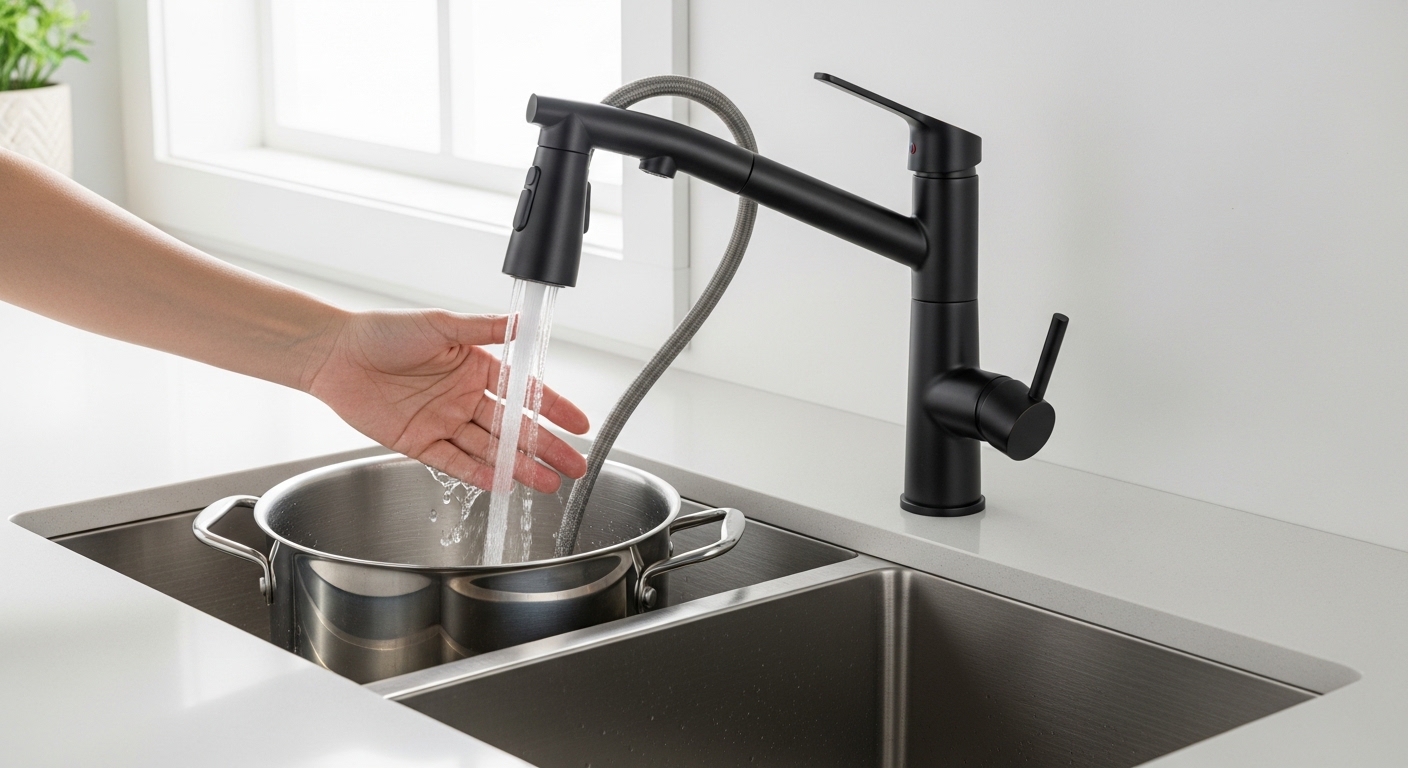
If you’ve been searching for a kitchen pull out kitchen faucet, you’re really asking one practical question: which one will actually make washing dishes, filling pots, and rinsing the sink easier — without leaking, drooping, or peeling within two years? That’s the question this guide answers. A pull-out faucet has a sprayhead that pulls straight out toward you on a flexible hose, which is what makes it so good at rinsing big pots, spraying down the basin, and watering plants on the windowsill. Below, we break down how to pick one, what the specs actually mean, and which features are worth paying for in 2026.
What’s the difference between a pull-out and a pull-down kitchen faucet?
A pull-out faucet has a sprayhead that pulls horizontally out toward you, while a pull-down faucet has a taller, gooseneck spout with a sprayhead that pulls straight down into the sink. That single difference drives almost everything else about how the faucet feels to use day to day.
Pull-out faucets usually have a lower, more compact spout, which makes them ideal for kitchens with a window or upper cabinet right behind the sink — there’s no tall arc in the way. Because the sprayhead comes toward you, they’re also great for filling pots that sit on the counter, not just in the basin. Pull-down faucets, with their dramatic high arc, give you more clearance for stacked dishes and look more “statement,” but they need vertical space above the sink.
| Feature | Pull-Out Faucet | Pull-Down Faucet |
|---|---|---|
| Spout height | Low to medium (good under windows) | High-arc gooseneck |
| Spray direction | Pulls toward you, horizontal | Pulls straight down |
| Best for | Small kitchens, windows, counter pot-filling | Deep sinks, large pots, bold look |
| Hose reach | Longer reach away from sink | Shorter, drops into basin |
| Typical price | $80–$220 | $100–$300 |
Neither is “better” in the abstract. If you have a window behind your sink or a smaller kitchen, the pull-out usually wins. If you fill stockpots and want maximum clearance, lean pull-down.
How much should I spend on a pull-out kitchen faucet?
Plan to spend $90–$250 for a quality pull-out kitchen faucet that will genuinely last 10 years or more. Below about $70 you start hitting plastic internals and zinc-alloy bodies that corrode; above $250 you’re mostly paying for premium finishes, smart features, or designer brand names — not necessarily better function.
Here’s where your money actually goes, from most to least important:
- Cartridge ($): A ceramic-disc cartridge is the single most important durability part — it’s what controls flow and stops drips. Cheap faucets cut corners here.
- Body material: Solid brass resists corrosion far better than zinc alloy (“ZAMAK”). Brass costs more but is why a faucet survives a decade of hard water.
- Hose and docking: A nylon-braided hose with a strong magnetic dock keeps the sprayhead snapping back into place instead of drooping over time.
- Finish: PVD (physical vapor deposition) finishes resist scratching and tarnish; cheaper electroplated finishes can flake.
- Sprayhead: Look for at least two modes — an aerated stream for filling and a stronger spray for rinsing.
If you’re weighing big-name brands at the higher end, our breakdown of Moen vs Delta vs Kohler is a useful reality check on what that premium actually buys you.
Which finish lasts longest and is easiest to keep clean?
For the best balance of durability and easy cleaning, brushed nickel and matte black hold up best on a pull-out faucet — both hide water spots and fingerprints far better than polished chrome. Polished chrome is the easiest to wipe streak-free but shows every droplet; spot-resist coatings help on any finish.
The sprayhead on a pull-out gets handled constantly, so fingerprint resistance matters more here than on a standard faucet. That’s the case for brushed and matte finishes. If you love the bright look of chrome, just know you’ll be wiping it more often. Whichever you choose, a good PVD or “spot-resist” coating is what keeps the finish looking new — and protecting it isn’t hard once it’s installed. Our guide on how to protect faucet finishes walks through the simple habits that prevent etching and dullness.
| Finish | Hides fingerprints | Hides water spots | Best for |
|---|---|---|---|
| Matte Black | Excellent | Excellent | Modern, high-contrast kitchens |
| Brushed Nickel | Very good | Very good | Warm, neutral, low-maintenance |
| Polished Chrome | Poor | Poor | Bright, classic, budget-friendly |
| Stainless / Brushed Steel | Good | Good | Matching stainless appliances |
What sprayhead and flow rate do I actually need?
For a family kitchen, you want a pull-out sprayhead with at least two spray modes and a flow rate of 1.5–1.8 GPM (gallons per minute). That range gives you enough pressure to blast stuck-on food off plates while still meeting water-efficiency standards.
Most modern pull-out faucets in the U.S. cap at 1.8 GPM, and many water-conscious models run 1.5 GPM. Don’t assume lower flow means weak rinsing — a well-designed aerator and spray nozzle deliver a strong, satisfying stream even at 1.5 GPM. If you’re curious how to verify a faucet’s efficiency claims, see our explainer on how to tell if a faucet is truly water-saving. The two modes you genuinely want are:
- Aerated stream — soft, splash-free flow for filling pots and glasses without splashing.
- Spray/jet — concentrated, higher-pressure spray for rinsing dishes and cleaning the sink.
- Pause (optional but handy) — a button that temporarily stops the water while you move the sprayhead, saving water and avoiding splashes.
If your home has hard water, a sprayhead with rubber spray nozzles is a small but real upgrade — you can wipe mineral buildup off the tips with your thumb instead of soaking the whole head in vinegar.
Will a pull-out faucet fit my sink, and can I install it myself?
Most pull-out kitchen faucets fit standard single-hole or three-hole sink configurations and can be installed by a confident DIYer in about 45–90 minutes with basic tools. The key is matching the number of mounting holes in your sink or countertop to the faucet’s setup — single-hole faucets often include an optional deck plate (escutcheon) to cover the extra holes of a three-hole sink.
Before buying, check three things: the number of sink holes, the depth of your cabinet (the hose and weight need room to move freely below), and your water-line connections. Most modern faucets use standard 3/8″ compression supply lines. If you’re replacing an old faucet first, our step-by-step guide on removing your old faucet without calling a plumber covers the part most people dread. And if you’re working from a specific brand’s instructions, the same principles in our DIY faucet installation walkthrough apply to nearly any pull-out model.
One pull-out-specific tip: the hose runs through the spout and connects to a counterweight under the sink. Make sure that weight can swing freely without snagging on the shut-off valves or garbage disposal — a snagged weight is the number-one reason a sprayhead won’t retract smoothly.
What are the most common pull-out faucet problems — and are they avoidable?
The three most common pull-out faucet complaints are a drooping sprayhead that won’t dock, low water pressure, and a leak where the hose meets the sprayhead — and all three are largely avoidable by choosing a quality faucet and installing it correctly. None of them are mysterious once you know the cause.
- Sprayhead won’t stay docked: Usually a weak or poorly placed counterweight, or a magnetic dock that’s too weak. Choose a model with a strong magnetic dock (not just a friction fit).
- Low or dropping pressure: Often a clogged aerator or sprayhead from mineral buildup — or a kinked hose under the sink. If you’re already seeing weak flow, our guide on fixing a low-flow kitchen faucet covers the quick fixes.
- Leaks at the sprayhead: A worn O-ring or hose washer, easily replaced for a few dollars.
- Drips from the spout after shutoff: Almost always a worn cartridge — which is why a ceramic-disc cartridge from the start matters so much.
The lesson: most “faucet failures” are really cheap-cartridge or weak-dock failures. Spend a little more upfront on those two parts and you sidestep the headaches entirely.
Is a pull-out kitchen faucet worth it in 2026?
Yes — for most kitchens, a pull-out kitchen faucet is absolutely worth it, especially if you have a window behind your sink, a smaller kitchen, or you frequently fill pots on the counter. The extra reach and rinsing power genuinely change how easy the sink is to use, and prices have come down while quality has gone up.
The main reasons to choose something else: if you have a very deep sink and wash a lot of tall stockpots, a high-arc pull-down gives more clearance; and if your budget is under $60, you may get a sturdier (if less flexible) standard faucet for the money. But for the vast majority of family kitchens, a mid-range pull-out is the most practical, satisfying choice you can make. A quality kitchen pull out kitchen faucet earns its keep every single day.
FAQ
How long does a good pull-out kitchen faucet last?
A quality pull-out faucet with a solid-brass body and ceramic-disc cartridge typically lasts 10–15 years. The hose and sprayhead are the wear parts — but both are inexpensive and replaceable, so the faucet itself can last far longer than the original sprayhead.
Can I replace just the sprayhead or hose on a pull-out faucet?
Yes. Sprayheads and hoses are standard replacement parts. As long as you match the thread type (most use a standard connector), you can swap a worn or leaking sprayhead in about ten minutes without removing the whole faucet — one of the biggest advantages of the pull-out design.
Why does my pull-out sprayhead keep falling down instead of docking?
This is almost always a counterweight or magnet issue. Check that the counterweight under the sink can move freely and isn’t snagged on a hose or valve. If the faucet uses a magnetic dock, a weak or misaligned magnet is the culprit — repositioning the hose or adjusting the weight position usually fixes it.
Are pull-out faucets good for low water pressure homes?
Yes, they can be. Choose a model rated around 1.8 GPM rather than an aggressively low-flow 1.0 GPM version, and keep the aerator and sprayhead clear of mineral buildup. A pressure-optimized aerator delivers a strong stream even when household water pressure is modest.
Do pull-out faucets meet U.S. lead-safety and water standards?
Reputable pull-out faucets are certified to NSF/ANSI 61 and 372 for lead-free drinking water and meet WaterSense efficiency guidelines. Always look for these certifications on the box or product listing — they’re your assurance the faucet is safe for potable water and won’t leach lead. For more on this, see our guide to removing lead from faucets safely.
What’s the best pull-out faucet finish for a kitchen with hard water?
Brushed nickel and matte black are best for hard-water kitchens because they camouflage the white mineral spotting that hard water leaves behind. Pair the finish with a sprayhead that has rubber (silicone) spray tips so you can wipe away limescale with your thumb instead of soaking the head.
Author note: This guide was written by the ivigafaucet product team, drawing on hands-on testing of pull-out, pull-down, and standard kitchen faucets across hundreds of installations and customer service cases. We evaluate faucets the way real households use them — repeated docking cycles, hard-water exposure, hose retraction over time, and cartridge longevity.
About ivigafaucet: ivigafaucet designs and supplies kitchen and bathroom fixtures built to recognized standards, including ceramic-disc cartridges rated for 500,000+ open-close cycles and finishes validated through salt-spray and abrasion testing. Our faucets are certified lead-free (NSF/ANSI 372) and backed by a limited lifetime warranty on the cartridge and finish. Learn more at www.ivigafaucet.com.