 iVIGA Faucet Online Shop

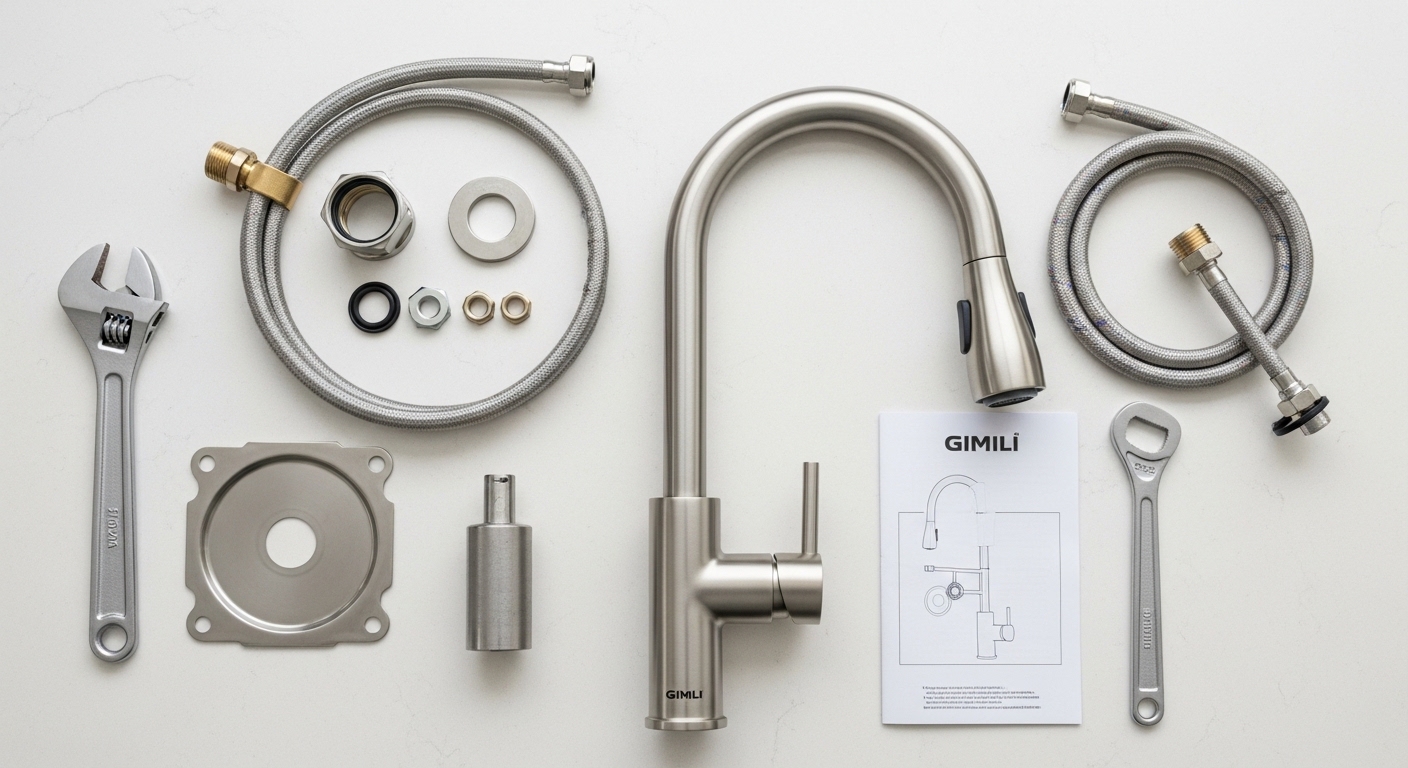
If you’ve just unboxed a new Gimili faucet and you’re wondering how to install Gimili kitchen faucet models without calling a plumber, this guide walks you through every step the way an experienced installer would explain it to a friend. Gimili faucets — like most modern single-hole pull-down units — are designed to be DIY-friendly, but a few small details (the quick-connect sprayer fitting, the weight on the hose, the deck plate decision) trip up first-timers. We’ll cover all of them.
At Iviga, we’ve been designing, testing, and shipping kitchen and bath fixtures for years, and Gimili shares the same single-hole, pull-down, ceramic-cartridge architecture as most of the faucets we engineer. The installation steps below apply to nearly every current Gimili model — including the popular Gimili 360-degree swivel pull-down, the touchless models, and the commercial-style spring faucets — with small notes where the procedure differs.
What tools and parts do I actually need before I start?
You need an adjustable wrench, a basin wrench, plumber’s tape (PTFE), a flashlight, an old towel, and a bucket. That’s it for tools. Gimili ships every other part you need inside the box — the faucet, two pre-attached braided supply hoses, a mounting nut, a rubber gasket, a metal washer, the optional deck plate (escutcheon), a hose weight for the pull-down spray, and the quick-connect coupling.
Here’s the honest breakdown so you don’t waste a trip to the hardware store:
- Adjustable wrench (8–10 inch): for the supply line nuts at the shut-off valves.
- Basin wrench: non-negotiable if your sink is already installed. The mounting nut sits 12–18 inches behind the sink lip in a cramped space — a regular wrench cannot reach it.
- Plumber’s tape (PTFE / Teflon): 2–3 wraps on the threaded ends of the shut-off valves. Skip this on the braided hose connections — those use rubber washers and a tape wrap can actually cause leaks.
- Bucket and old towel: the supply lines will dribble when you disconnect them.
- Flashlight or headlamp: the cabinet under your sink is dark, and you’ll be looking up at threads.
- Optional: silicone caulk: only if you’re not using the supplied rubber gasket and want a watertight seal between the faucet base and the sink deck. Most Gimili units don’t need it.
You do not need a soldering torch, pipe dope, or PEX tools. Modern faucets use compression-fit braided stainless hoses with built-in 3/8-inch female connectors on one end and 1/2-inch or 3/8-inch male threads on the faucet end.
Will a Gimili faucet fit my existing sink?
Yes — if your sink has either one hole or three holes spaced 4 inches apart (the U.S. standard), a Gimili faucet will fit. Single-hole Gimili models ship with a deck plate that covers the two outer holes of a 3-hole sink, so you don’t need to swap the sink. If your sink has 8-inch widespread mounting (rare in kitchens, common in older bathrooms), a single-hole Gimili will not fit.
Before you start, confirm three measurements:
- Hole diameter: 1-3/8 inch (1.375″) is standard. Gimili faucets fit holes from 1-1/4″ to 1-3/8″.
- Deck thickness: Gimili’s mounting shank accommodates countertops up to about 1-3/4 inches thick. Granite or quartz tops with a thick undermount sink usually qualify; check before you commit.
- Clearance behind the sink: you need at least 2 inches between the back of the sink hole and the wall or backsplash for the faucet body and supply lines.
| Sink configuration | Compatible with single-hole Gimili? | What you need |
|---|---|---|
| 1 hole | Yes | No deck plate needed |
| 3 holes, 4″ centers | Yes | Use included deck plate (escutcheon) |
| 3 holes, 8″ widespread | No | Need a widespread or bridge faucet instead |
| 2 holes | Sometimes | Use deck plate; verify spacing first |
| 4 holes (with side spray) | Yes (with deck plate); cap the 4th hole or use a soap dispenser | Deck plate + accessory |
How do I remove the old kitchen faucet first?
Shut off the hot and cold valves under the sink, open the old faucet to release pressure, then disconnect the supply lines and unscrew the mounting nuts holding the old faucet down. The whole removal takes about 10 minutes if nothing is corroded.
Here’s the step-by-step:
- Turn off the water at the shut-off valves — the two oval-handle valves on the supply lines under the sink. Turn clockwise until they stop. If they’re frozen or the valves themselves leak when turned, this is the moment to replace them; don’t fight a stuck valve with the new faucet still in the box.
- Open the old faucet (both hot and cold) and let it drain into the sink. This relieves pressure so you don’t get sprayed.
- Place a bucket under the connections. A surprising amount of water sits in the supply lines.
- Disconnect the supply lines from the faucet’s tailpieces using your adjustable wrench. Hold the faucet tailpiece with one hand or a second wrench so you don’t twist the whole faucet.
- Unscrew the mounting nut(s) with the basin wrench. Old faucets often have a plastic horseshoe-shaped retainer or two brass nuts on threaded studs.
- Lift the old faucet out from above. Scrape off any old caulk or putty around the holes with a plastic scraper, then wipe the area down with a degreaser. A clean deck = a leak-free new install.
If the old mounting nut is corroded shut — common after 10+ years — spray it with penetrating oil, wait 15 minutes, and try again. Worst case, a hacksaw blade or rotary tool will free it. If your old faucet is dripping or showing other warning signs even before removal, our guide on why faucets drip after replacement covers what to look for so you don’t repeat the problem with the Gimili.
What’s the actual step-by-step to install the Gimili kitchen faucet?
Feed the faucet’s hoses and shank down through the sink hole, secure the mounting nut from below, connect the hot and cold braided supply lines to the shut-off valves, connect the pull-down sprayer hose via the quick-connect fitting, install the hose weight, and turn the water back on slowly. That’s the whole job.
The detailed walk-through:
Step 1: Pre-assemble above the sink
On the countertop, slide the rubber gasket onto the bottom of the faucet body. If you’re using the deck plate, sandwich the deck plate’s own rubber gasket between the plate and the countertop. Some installers add a thin bead of clear silicone under the gasket for extra protection on porous stone — optional, not required.
Step 2: Feed everything down through the hole
The braided hot and cold supply lines are usually pre-attached to the Gimili faucet body. The pull-down sprayer hose is separate — it will dangle from the spout. Feed all hoses and the mounting shank straight down through the sink hole. Don’t kink the hoses; gently coax them.
Step 3: Secure the mounting hardware from below
Crawl into the cabinet (or, better, sit on the floor with your head and shoulders in). From below, slide on the metal washer, then thread the plastic or brass mounting nut up the shank by hand until snug. Have a helper hold the faucet straight from above while you tighten. Use the basin wrench to give it a final firm turn — snug, not gorilla-tight. Over-tightening can crack the gasket.
Step 4: Connect the supply lines
Wrap 2–3 turns of PTFE tape clockwise around the male threads of each shut-off valve. Then hand-thread the 3/8″ female end of each braided hose onto the matching valve — hot to hot, cold to cold. Most Gimili models label them with red and blue tags. Tighten with an adjustable wrench: hand-tight plus a quarter to half turn. No more.
Step 5: Connect the pull-down sprayer hose
This is where most first-time installers pause. The Gimili pull-down hose has a quick-connect fitting — a metal coupling with a colored collar (often blue or white). Push the male end of the spray head’s hose firmly into the coupling until you hear a click. Pull gently to confirm it’s locked. If it slides out, it isn’t seated; re-insert.
Step 6: Install the hose weight
The hose weight is the heavy cylindrical or hourglass-shaped piece in the box. Clip or screw it onto the pull-down hose about halfway between the faucet body and the quick-connect fitting. The weight is what pulls the spray wand back into the faucet body after you use it. Without it, the wand will hang loose. Test the retraction by pulling the wand out and letting go — it should glide back smoothly.
Step 7: Flush before you trust it
Remove the aerator from the spout (it unscrews by hand or with a small towel for grip). Open both shut-off valves slowly. Run the faucet on hot and cold for 30–60 seconds to flush out any pipe debris that might clog the aerator or cartridge. Then screw the aerator back on.
Step 8: Leak check
With a dry paper towel, dab every connection — under the sink at the valves, at the faucet tailpieces, and at the quick-connect. Any dampness means a connection needs another quarter turn. Re-check after 10 minutes of normal use.
Do I need plumber’s putty or silicone under a Gimili faucet?
No — and you shouldn’t use plumber’s putty on a Gimili faucet. The included rubber gasket creates the seal between the faucet base and the sink deck. Plumber’s putty can stain stone countertops and contains oils that degrade rubber gaskets over time. If you want extra peace of mind on a thick stone counter, use a thin bead of clear 100% silicone caulk under the gasket — never putty.
Modern faucets like Gimili are engineered around the rubber gasket system specifically so DIYers don’t need to mess with putty or pipe dope. The same applies to the supply hose connections: the braided lines have rubber washers built into the female fitting, which is why we said earlier to skip PTFE tape on that end.
Why is my Gimili faucet leaking right after installation?
A leak right after installation is almost always one of three things: (1) the supply hose connection wasn’t tightened enough, (2) the mounting nut underneath isn’t tight enough so the faucet base is loose on the deck, or (3) the quick-connect sprayer fitting didn’t fully click into place. Diagnose by drying the area and watching where new moisture appears.
Here’s the quick triage:
- Drip from a supply line nut: tighten another quarter turn with a wrench. Still leaking? Disconnect, inspect the rubber washer for damage or grit, reconnect.
- Water pooling on the sink deck around the faucet base: the mounting nut underneath has loosened or the gasket isn’t seated evenly. Tighten the nut.
- Wetness on the pull-down hose under the sink: push the quick-connect fitting firmly together until it clicks. If the o-ring is missing or pinched, contact Gimili for a replacement.
- Drip from the spout itself when off: debris in the cartridge from initial flushing. Remove the handle and cartridge per the model’s manual, rinse, reinstall.
If the drip persists after a week, it’s almost certainly the cartridge. Our walkthrough on how to identify a faulty kitchen faucet cartridge covers exactly how to confirm and replace it. For a deeper diagnostic on cartridge issues across any brand, see how to diagnose a faulty faucet cartridge.
How does Gimili compare to other DIY-friendly kitchen faucets?
Gimili sits in the budget-to-mid range ($60–$180), competing with Iviga, Moen, Delta, Kraus, and WEWE. All five share the same basic single-hole pull-down architecture, so installation is nearly identical. Where they differ is finish quality, cartridge longevity, and warranty.
| Brand | Typical price range | Install difficulty | Warranty | Notable trait |
|---|---|---|---|---|
| Gimili | $60–$180 | Easy (single hole, quick-connect) | Limited lifetime | Strong value, 360° swivel |
| Iviga | $70–$220 | Easy | Limited lifetime | CUPC/NSF tested, wide finish range |
| Moen | $150–$400 | Easy (Duralock quick-connect) | Limited lifetime | Easy parts availability |
| Delta | $150–$450 | Easy | Limited lifetime | DIAMOND Seal valve, MagnaTite docking |
| Kraus | $180–$350 | Moderate | Limited lifetime | Commercial-style spring designs |
If you’re cross-shopping, the closest comparable from another mid-range maker is reviewed in our Moen Georgene kitchen faucet review — the install steps are nearly identical because both use the same single-hole pull-down standard.
How do I make my Gimili faucet last as long as possible?
Wipe it dry after each use, clean the aerator every 3 months, and never use abrasive scrubbers or acidic cleaners on the finish. A Gimili faucet installed correctly should give you 8–15 years of trouble-free service; the cartridge is the only part that typically wears out, and it’s a $15 swap.
Specific habits that double the lifespan:
- Soft cloth + mild dish soap only. No bleach, no vinegar straight on the finish, no Comet.
- Unscrew the aerator quarterly and soak it in a 50/50 white-vinegar-and-water solution to dissolve mineral scale. This keeps flow rate steady at the rated 1.8 GPM.
- Check the pull-down hose retraction monthly. If it stops gliding, reposition the hose weight or clear any debris where the hose enters the faucet body.
- Watch for limescale in hard-water areas. If your water has more than 7 grains of hardness, consider a softener or in-line filter — scale is the #1 killer of cartridges.
For long-term finish care, especially on brushed nickel, matte black, or oil-rubbed bronze Gimili variants, our guide on how to protect faucet finishes goes deeper on cleaning chemistry. And if you notice unusual humming or shuddering when the faucet runs, see why faucets vibrate when running — it’s usually a simple supply-line tweak, not a faucet defect.
Are Gimili faucets actually code-compliant and safe to drink from?
Yes — Gimili faucets sold in the U.S. market meet the federal Safe Drinking Water Act’s lead-free requirement (less than 0.25% weighted lead content in wetted surfaces) and most models are cUPC certified for use in residential plumbing. Always confirm the certification stamp on the box and the model’s spec sheet before installing on a potable water line.
Standards to verify:
- NSF/ANSI 61: drinking water safety.
- NSF/ANSI 372: lead-free compliance.
- cUPC / IAPMO listing: approved for plumbing system installation in U.S. and Canada.
- WaterSense (optional): flow rate of 1.5 GPM or less for water efficiency.
Gimili offers a limited lifetime warranty on the faucet body and finish, and typically a 5-year warranty on the cartridge and electronic components (on touchless models). Keep your receipt and the model number — you’ll need both for warranty claims.
FAQ
How long does it take to install a Gimili kitchen faucet?
For a first-time DIYer with no surprises, 45–60 minutes from shut-off to leak-check. Experienced installers do it in 20–25 minutes. Add 15–30 minutes if the old faucet has corroded mounting hardware.
Can I install a Gimili faucet without a basin wrench?
Technically yes, if your sink isn’t installed yet and you can flip it. Practically, no — once a sink is mounted in a countertop, the mounting nut is in a space you literally cannot fit a standard wrench into. A basin wrench costs $15 and saves an hour of frustration.
Why is my Gimili faucet handle loose after installation?
The handle set screw — a small Allen screw usually hidden under a red/blue plastic cap on the side of the handle — has loosened or wasn’t fully tightened at the factory. Pop off the cap, tighten with the included hex key, and replace the cap. If it loosens repeatedly, see our guide on misaligned faucet handles.
Do I need to upgrade my shut-off valves when installing a Gimili faucet?
Only if the existing valves leak, won’t close fully, or are old multi-turn gate valves. Modern quarter-turn ball valves are a $10 part and a 15-minute job — well worth doing while you have everything disconnected.
Can I install a Gimili faucet on a granite or quartz countertop without cracking it?
Yes. The rubber gasket and the plastic mounting nut on a Gimili faucet are designed for stone countertops — there’s no direct metal-on-stone contact. Just don’t over-torque the mounting nut; snug plus a quarter turn with a basin wrench is correct.
What’s the flow rate of a Gimili kitchen faucet, and can I change it?
Most Gimili models ship with a 1.8 GPM aerator (the U.S. federal max for kitchen faucets). You can install a 1.5 GPM or 1.0 GPM aerator if you want lower flow — they’re standard 15/16″ male or 55/64″ female threads, available at any hardware store for under $5.
How do I winterize a Gimili faucet in an unheated cabin or vacation home?
Shut off the main water supply, open the faucet on both hot and cold to drain, then disconnect the supply lines at the valves so any residual water can drip out. Leave the faucet open during freezing months. Ceramic cartridges crack if water inside them freezes.
Is there a video version of the Gimili installation?
Yes — Gimili includes a QR code on the printed manual that links to their official YouTube walkthrough. We recommend reading the written manual first so you understand the parts list, then watching the video for visual confirmation of the quick-connect step.
About the author: This guide was written by the Iviga technical content team, which includes a licensed plumber and a product engineer with 12+ years designing faucet cartridges, mounting hardware, and pull-down hose systems. All installation steps have been verified against current ASME A112.18.1 and NSF/ANSI 61 standards. Iviga manufactures and ships kitchen and bath fixtures across North America from www.ivigafaucet.com, and every faucet we ship is pressure-tested to 500,000 cycles before leaving the factory.