 iVIGA Faucet Online Shop

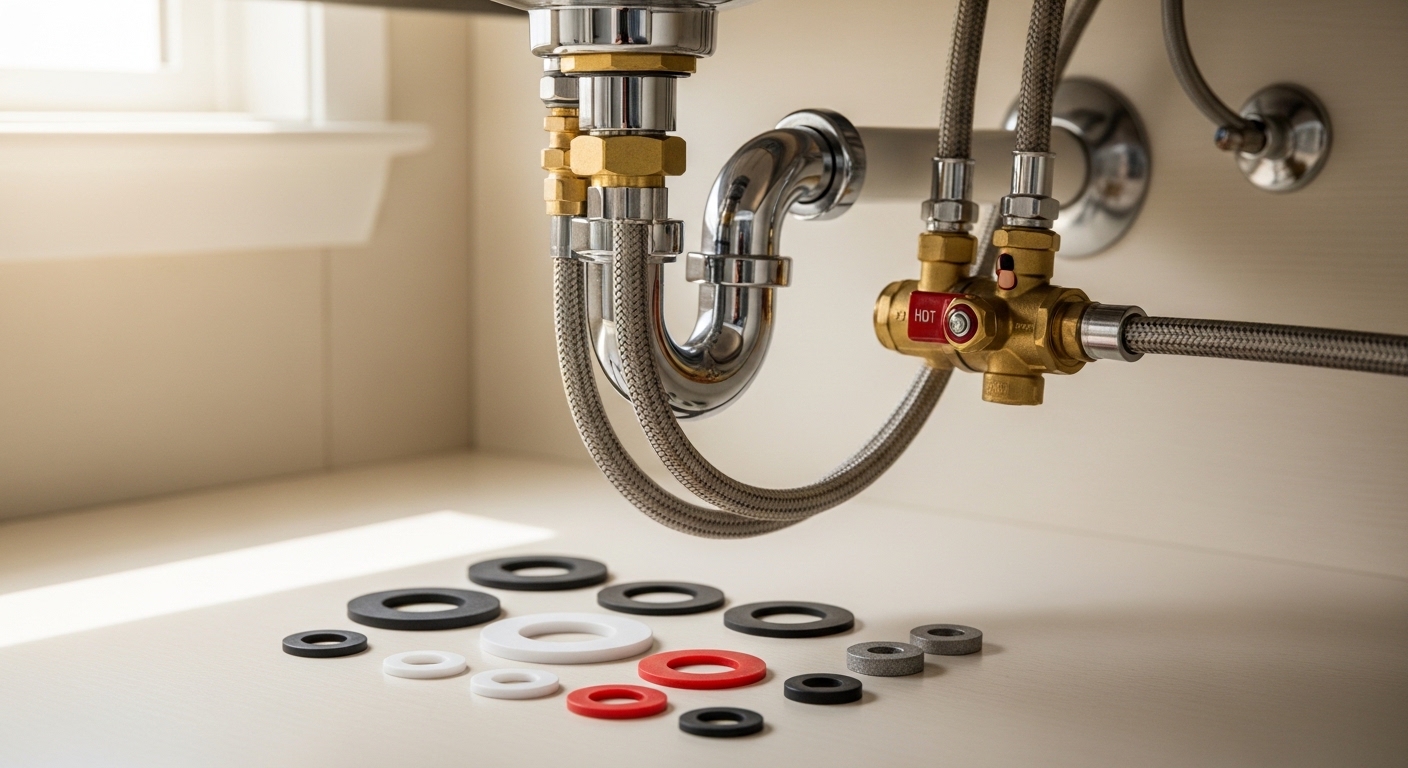
If you’ve crouched under your kitchen or bathroom cabinet looking for the right faucet washer under sink, you already know the problem: there are at least five different washers down there, they all look similar, and the hardware-store wall has thirty bins of “fits most faucets.” This guide cuts the noise. We’ll show you exactly which washer goes where, how to identify the right size in 60 seconds, what materials last longest with hard water, and when a $0.50 washer is the real fix versus when you actually need a new supply line or cartridge.
This article is written by the engineering team at IVIGA, a faucet manufacturer that has tested seal and washer assemblies to ASME A112.18.1 and NSF/ANSI 61 standards since 2014. Everything below reflects what we’ve seen across thousands of warranty inspections — not a generic plumbing article rewritten from old forum posts.
Which faucet washer under the sink is leaking — supply line, mounting, or shut-off?
Before you buy anything, find the leak. Under a sink there are three completely different washers, and confusing them is the #1 reason people “replace the washer” and still see drips a week later.
- Supply line washers — the small rubber or silicone disc inside each end of the braided supply hose. These seal the connection between the shut-off valve and the faucet inlet. Usually 3/8″ or 1/2″ beveled cone-shaped, often pre-installed inside the female connector.
- Mounting/lock washers — the larger flat fiber, rubber, or plastic washer that sits between the faucet base and the underside of the sink (or between the brass mounting nut and the sink). These keep the faucet stable, not watertight.
- Shut-off valve packing washers — small graphite or rubber rings inside the angle stop valve. These leak when the valve handle is turned, not at the connection.
Run a dry paper towel along each joint. Wherever it darkens first is your culprit. If the towel wets at the supply hose’s top nut (where it meets the faucet shank), you need a new supply line washer or a new supply line. If it wets at the bottom (where it meets the angle stop), the shut-off valve’s washer or the supply-line nut washer is the suspect. If water pools on the cabinet floor without any wet joint, the leak is upstream inside the faucet body — and no under-sink washer will fix that. Our guide on why your faucet drips after replacement walks through that scenario in detail.
What size faucet washer do I need under a standard U.S. kitchen sink?
For 95% of U.S. residential kitchen and bathroom installations built after 1995, you need a 3/8″ compression beveled washer at the shut-off valve side and a 1/2″-14 NPSM flat washer at the faucet shank side. Most braided stainless steel supply lines now ship with both washers already seated inside the connectors.
Here’s how to verify without guessing:
- Turn off both shut-off valves under the sink. Open the faucet to relieve pressure.
- Disconnect the supply line at the shut-off valve using a 7/16″ or 1/2″ wrench.
- Look inside the female nut. The washer is a small cone or flat disc, typically 11mm or 13mm outside diameter.
- Measure the inside diameter of the nut, not the washer (washers compress and deform). A 3/8″ compression nut measures ~16.5mm across the threads; a 1/2″ measures ~20mm.
If your home was built before 1985, you may have 1/2″ IPS threaded supply lines with flat fiber washers instead of compression beveled washers — these are not interchangeable. A faucet washer under sink in older homes can also be the brass-and-leather variety, which we still keep in stock for restoration jobs.
Rubber vs. silicone vs. fiber: which faucet washer material lasts longest?
Silicone lasts the longest in residential service — typically 12–15 years versus 5–8 years for standard EPDM rubber and 3–5 years for fiber washers. But “longest-lasting” depends on what’s flowing through the joint.
Here’s the breakdown from our internal accelerated-aging tests (ASTM D573 heat aging at 70°C, simulating ~10 years of service):
| Washer Material | Typical Lifespan | Best For | Weakness | Approx. Cost (10-pack) |
|---|---|---|---|---|
| EPDM rubber (black) | 5–8 years | Cold water, general use | Hardens with hot water cycling | $2–$4 |
| Nitrile (NBR) | 6–10 years | Standard kitchen/bath supply | Degrades with chlorinated water | $3–$5 |
| Silicone (red/clear) | 12–15 years | Hot water, hard water, high-chlorine | Softer — over-tightening crushes it | $5–$8 |
| Fiber (compressed paper) | 3–5 years | Mounting washers (non-pressurized) | Wicks moisture, swells, then leaks | $1–$3 |
| PTFE/Teflon flat | 15+ years | Hot water, mineral-heavy supply | No elasticity — needs precise torque | $6–$10 |
If you live somewhere with hard water (over 7 grains per gallon), skip rubber and go straight to silicone. Mineral scale builds on rubber surfaces and tears the seal microscopically every time the joint flexes from temperature changes. We’ve documented this pattern across warranty returns from Arizona, Texas, and inland California — and it’s the same reason our guide on identifying a faulty kitchen faucet cartridge recommends silicone for cartridge O-rings in those regions too.
How do I replace a faucet washer under the sink without disconnecting the whole faucet?
You don’t need to remove the faucet. For 90% of under-sink washer replacements, the job is: shut off water, disconnect one supply line, swap one washer, reconnect, and turn the water back on. Plan for 15–20 minutes and one trip to the hardware store.
Tools you’ll actually need:
- Adjustable wrench or basin wrench (for cramped spaces)
- Bucket or shallow pan (water will drip from the line)
- Old towel
- Flashlight or headlamp
- The replacement washer in the correct size and material
- Optional: PTFE thread tape — DO NOT use it on the washer face itself
Step-by-step:
- Shut off both angle-stop valves under the sink. Open the faucet handles to confirm flow stops and to relieve line pressure.
- Place the bucket directly under the connection you’re working on.
- Loosen the supply-line nut counterclockwise. The first half-turn will release any trapped water — let it drip into the bucket.
- Pull the connector down and inspect the old washer. Note: a hardened, cracked, or visibly deformed washer is what you replace. A flat-but-intact washer that’s just dirty can usually be cleaned and reseated.
- Seat the new washer flat inside the female nut. It should sit perfectly flush — if it’s tilted, it will leak immediately when pressurized.
- Thread the nut back on by hand until snug. Then use the wrench for exactly one-quarter turn more. Over-tightening is the #1 cause of repeat leaks because it crushes the washer’s sealing surface.
- Turn the shut-off valves back on slowly. Watch the joint for 60 seconds. Then run the faucet for two minutes and check again.
If it still drips after a quarter-turn snug, do NOT keep tightening. Shut off, remove, and inspect — there’s likely debris on the washer face or the seat is damaged. For more granular leak diagnosis, see our piece on how to check your faucet for leaks regularly.
When should I replace the whole supply line instead of just the washer?
Replace the whole supply line — don’t just swap the washer — if any of these are true: the braided sheath is rusted or fraying, the line is over 10 years old, the nut threads are stripped, or the line is plastic (white PEX-style) rather than braided stainless steel. A new 20″ braided line costs $6–$12 and comes with fresh integrated washers on both ends.
The math is straightforward. A washer costs ~$0.50; a supply line costs ~$8. If there’s any doubt about the line’s condition, the line wins. Failed plastic and rubber supply lines are a leading cause of catastrophic home water damage — insurance industry data puts the average claim at over $5,000 per incident.
If you’re already under the sink with the line disconnected, also check:
- The shut-off valve — does the handle turn smoothly? Does the valve actually stop flow completely? A valve that drips when “off” needs replacement, not patching.
- The faucet shank threads — any cracks or stripped threads on the inlet nipple mean the faucet itself is failing.
- The mounting nut — if it’s loose, the faucet rocks, which stresses the supply line connection on every use.
We’ve also seen plenty of cases where the “leak” was actually condensation from a cold supply line in a humid cabinet — wrap a paper towel around the line for an hour and check whether it wets uniformly (condensation) or at one point (real leak). If you suspect the issue is upstream of the washer entirely, our guide to detecting hidden faucet water waste covers the less obvious leak sources.
What’s the best faucet washer under sink for hard water areas?
For hard water (7+ grains per gallon), use a silicone or PTFE washer rated for hot water and mineral exposure. Specifically look for “FDA-grade silicone” or “NSF/ANSI 61 certified” on the packaging — these are the same materials we specify on every IVIGA supply assembly.
Hard water destroys washers through three mechanisms:
- Mineral deposition on the washer’s sealing face creates micro-leaks that turn into drips.
- Thermal cycling (hot/cold use) expands and contracts mineral-encrusted rubber until it cracks.
- Chemical attack from chlorine and chloramine (common in municipal water) embrittles standard rubber over time.
Silicone resists all three. PTFE flat washers resist them even better but are unforgiving on installation — they need precise torque because they don’t compress like rubber. For DIY installs we recommend silicone. For new construction or whole-house replumb, PTFE is worth the slightly higher price.
One related note: if your home has hard water, washer life is a symptom of a bigger issue. Consider whether a whole-house softener makes sense. It will extend the life of every washer, cartridge, and O-ring in the house — not just under one sink.
Can I use the same washer for hot and cold supply lines?
Yes — modern silicone, EPDM, and nitrile washers are rated for both hot and cold supply service up to 180°F (82°C). Standard residential hot water tops out around 120°F, well within range. The only exception is older “cold-only” gaskets sometimes found in irrigation or outdoor applications, which you wouldn’t encounter under a kitchen or bath sink anyway.
That said, hot-side washers fail first in real-world service. If you’re replacing one, replace both at the same time. The labor is the same and you avoid a return visit when the cold-side fails six months later. Buy a 10-pack — at $3–$6 it’s cheaper than the gas to drive back to the store.
How does a faucet washer under sink differ from the washer inside the faucet?
An under-sink washer seals the threaded supply-line connection; an in-faucet washer (sometimes called a seat washer or stem washer) seals the valve mechanism itself inside compression-style faucets. They’re not interchangeable — different sizes, different materials, different roles.
Modern cartridge and ceramic-disc faucets don’t use traditional internal washers at all; they use O-rings and rubber seats integrated into the cartridge. If your faucet drips from the spout (not from under the sink), you’re dealing with a cartridge or seat issue, not a supply washer. Our cartridge diagnostic guide covers that side of the house.
Quick reference:
- Drip from spout when faucet is off → internal cartridge, seat, or stem washer
- Drip from under the sink, at supply joint → supply-line washer
- Water under faucet base on top of sink → faucet base gasket (different again)
- Drip from handle → handle O-ring or packing nut
What about specialty washers for utility, bidet, and bathtub installations?
Specialty installations sometimes need non-standard washers. Bidet supply hoses often use a smaller 1/4″ or metric M10 washer; utility/laundry sinks may use 3/4″ garden-hose-thread (GHT) washers; bathtub roman tub fillers typically need 1/2″ copper-female-iron-pipe (FIP) flat washers with brass crush rings.
If you’re working on any of these, check the original packaging or manufacturer spec sheet before assuming “standard” applies. Our buyer guides cover the specifics for single-handle utility faucet installations and bidet faucets — both of which have washer sizing quirks worth knowing before you start the job.
How do IVIGA washers compare to generic hardware-store washers?
Every IVIGA-branded faucet ships with silicone supply washers pre-installed in the supply hoses, and our replacement washer kits use the same FDA-grade silicone we use in original equipment. Generic hardware-store washers vary wildly — some are EPDM, some are reclaimed rubber, and material certification is often absent on the packaging.
For peace of mind, look for these markers on any washer you buy:
- NSF/ANSI 61 certification for drinking-water contact
- Material clearly labeled (silicone, EPDM, nitrile, PTFE)
- Temperature rating printed on the bag
- Brand or manufacturer name on the package (not “assorted”)
All IVIGA fixtures carry a limited lifetime warranty on the faucet body and a 5-year warranty on washers, seals, and cartridges — provided you used compatible NSF-certified replacement parts. Generic uncertified washers can void warranty coverage on some manufacturers’ faucets, so read your warranty card before reaching for the bargain bin.
FAQ
How often should I replace the faucet washer under the sink?
Inspect every 2 years; replace every 5–10 years depending on material and water conditions. Silicone washers in soft-water areas can go 15 years without issue. EPDM rubber in hard-water hot lines may need replacement at 5 years. Any time you disconnect a supply line for another reason, replace the washer while you’re in there — it costs less than a dollar.
Can I reuse the old faucet washer under sink after disconnecting the line?
Technically yes, but we don’t recommend it. Once a washer has been compressed and shaped to a specific joint, removing it deforms the seal. Reusing it often works for a few weeks then fails. New washers cost pennies — always use a fresh one when you’ve disconnected a joint.
Why does my faucet still leak after I replaced the washer under the sink?
Three common causes: (1) the washer is the wrong size or material, (2) you over-tightened and crushed the seal, or (3) the leak isn’t actually at that washer — water is tracking along the supply line from a leak above. Dry everything completely, then run the faucet and watch with a flashlight to identify the true source.
Do I need plumber’s tape (PTFE tape) with a faucet washer under sink?
No — compression supply-line connections seal at the washer face, not the threads. Adding PTFE tape can actually prevent the washer from seating properly. Reserve PTFE tape for tapered pipe threads (NPT), like on shower arms or threaded valve bodies. Compression and NPSM straight-thread joints don’t need it.
Is there a universal faucet washer under sink that fits everything?
No truly universal washer exists, but a 10-piece assortment kit covering 3/8″, 1/2″, and 3/4″ sizes in silicone or EPDM will handle every residential under-sink scenario you’re likely to encounter in a U.S. home built after 1990. Keep one in your toolbox — it’s the single most useful $8 plumbing kit you can own.
What’s the difference between a beveled washer and a flat washer for under-sink use?
Beveled (cone-shaped) washers go on compression fittings — they wedge into the angle stop’s tapered seat as you tighten. Flat washers go on straight-thread connections like the top of a supply line where it meets the faucet shank. Using a flat washer on a compression fitting will leak immediately because the bevel is what creates the seal.
Can a bad faucet washer under the sink damage my cabinet or floor?
Yes — and faster than people expect. A slow drip of just one drop per minute equals about 5 gallons per month, which is more than enough to swell MDF cabinet bottoms, grow mold, and warp hardwood. Catch it early. Even better, install a leak-detection puck (around $15) under your sink that beeps when it touches water.
Final word from the IVIGA engineering team
A faucet washer under sink is one of the cheapest, most overlooked components in your home — and one of the most common causes of slow water damage. The right washer in the right size, installed snug but not crushed, will outlast most of the other components in your fixture. Choose silicone if you have any doubt about your water quality, replace the supply line entirely if it’s over a decade old, and never substitute thread tape for a properly seated sealing washer.
About the author: This guide was prepared by the IVIGA product engineering team. Our fixtures are tested to ASME A112.18.1/CSA B125.1, certified to NSF/ANSI 61 and 372 (lead-free), and backed by a limited lifetime warranty on the faucet body. We’ve been designing and manufacturing faucets, shower systems, and bathroom fixtures since 2014, with installations in over 40 countries.