 iVIGA Faucet Online Shop

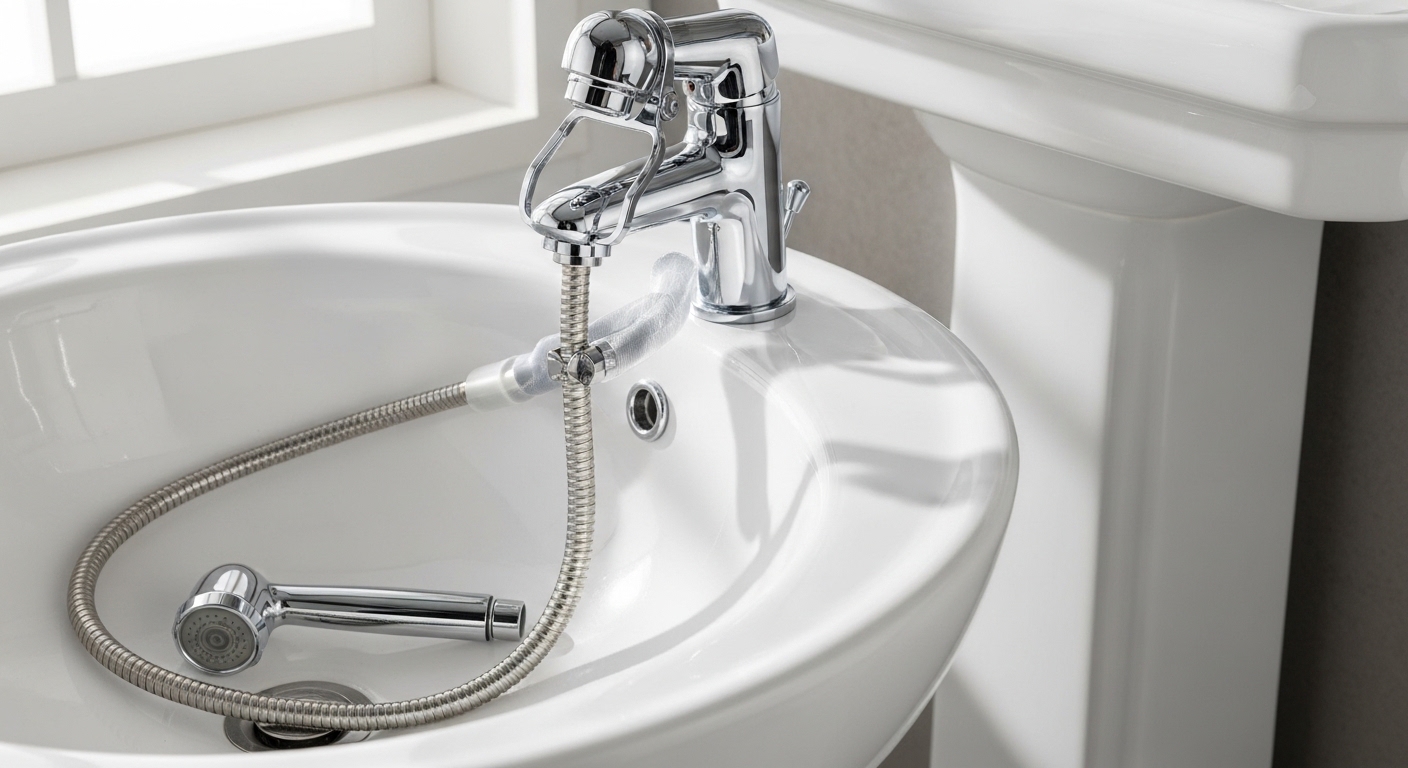
If you’ve ever tried to rinse shampoo out of your child’s hair in a pedestal sink, bathe a wriggling dachshund in a clawfoot tub, or help an elderly parent wash up without dragging them into a full shower stall, you already know why a faucet extender shower is one of the most underrated bathroom upgrades you can buy. Unlike a permanent shower install, a faucet extender shower attaches directly to an existing spout in minutes, gives you a flexible 4-to-6-foot hose with a real sprayer head, and removes in seconds when you don’t need it. At ivigafaucet, we’ve spent the last decade engineering faucets, diverters, and aerator accessories — and this guide is the no-nonsense breakdown we wish every shopper had before they clicked “Add to Cart.”
What Is a Faucet Extender Shower and Why You Need One
A faucet extender shower — sometimes called a sink shower attachment, faucet-to-shower converter, or handheld faucet sprayer — is a compact device that fits over the end of a standard bathroom or bathtub faucet and routes the water flow through a flexible hose into a small handheld shower head. The base unit either screws onto the aerator threads (for kitchen-style spouts) or slips over the spout like a sleeve and tightens with a rubber gasket clamp (for tub spouts and pedestal sink faucets without threads). A diverter lever lets you switch between the regular spout and the handheld sprayer instantly.
The appeal is simple. A full shower retrofit can run $1,500 to $4,000 in plumbing, tile, and labor. A quality faucet extender shower runs $20 to $90 and installs without tools. For renters, RV owners, parents of small kids, pet groomers, and aging-in-place households, it solves a daily problem without touching the wall behind your vanity.
The Most Common Use Cases
- Bathing infants and toddlers in a kitchen sink or shallow tub, where rinsing under a fixed spout is awkward and chilly.
- Washing hair over a bathroom basin without leaning all the way under the tap — a lifesaver after a fresh dye job or for anyone with back or shoulder pain.
- Pet grooming in the tub or laundry sink. Dogs, cats, and even rabbits cooperate far better with a gentle handheld spray than a hard fixed stream.
- Rinsing the tub itself after cleaning — no more cupping water in your hands or hauling a bucket.
- Accessible bathing for elderly users or anyone recovering from surgery who needs a seated wash but can’t safely transfer into a standing shower.
- RV, boat, and tiny-home plumbing where a permanent shower head simply won’t fit but a handheld extender can stow in a drawer.
The Four Main Types of Faucet Extender Showers
Not every faucet extender shower fits every faucet. The mounting style is the single biggest predictor of whether the unit will work in your bathroom, so this is where you should start your research — long before you compare finishes or hose lengths.
1. Threaded Aerator-Mount Extenders
These screw directly onto the male or female aerator threads of a standard kitchen or bath faucet (usually 15/16″-27 male or 55/64″-27 female). They give the most leak-resistant connection because the seal is metal-on-rubber-on-metal, just like a normal aerator. The trade-off: they only fit faucets that have removable aerators with standard threading. Many modern designer faucets use proprietary threads and won’t accept a universal extender.
2. Rubber Sleeve Slip-On Extenders
Designed for tub spouts and older pedestal sink faucets without threads, these use a thick rubber sleeve that slides over the spout and is compressed with a hose clamp or set screw. They’re the most universal, but they’re also the most prone to slipping or popping off under high water pressure if the spout is unusually short or tapered.
3. Diverter-Tee Extenders
These replace the aerator entirely with a small T-shaped diverter that has two outputs: one continues to act as a normal spout, and the other feeds the handheld hose. Flip the lever and water reroutes. These give the cleanest look and the most positive on/off control.
4. Bathtub Spout Replacement Extenders
For tubs without an existing shower, you can swap the entire tub spout for a new spout that has a built-in handheld diverter. This is the most permanent option, requires a wrench, and works best in tubs that have a threaded or slip-fit spout pipe in good condition.
Comparison Table: Faucet Extender Shower Types at a Glance
| Type | Best For | Typical Price | Install Time | Leak Risk | Removable? |
|---|---|---|---|---|---|
| Threaded Aerator-Mount | Kitchen + threaded bath faucets | $15–$40 | 2 minutes | Very low | Yes, fully |
| Rubber Sleeve Slip-On | Tub spouts, vintage faucets | $10–$25 | 5 minutes | Medium | Yes, fully |
| Diverter-Tee | Daily use, multi-user households | $30–$70 | 3 minutes | Low | Yes, fully |
| Spout Replacement | Permanent tub upgrade | $45–$120 | 15–25 minutes | Very low | Semi-permanent |
Faucet Extender Shower vs. Permanent Handheld Shower: Which Should You Buy?
This is the question that drives most of the search traffic for the term faucet extender shower. Buyers are weighing a quick, reversible accessory against a more involved plumbing project. The honest answer depends on three variables: how often you’ll use it, who owns the bathroom, and what your existing plumbing looks like.
If you rent, if your tub or sink is the only bathing surface for a baby or pet, or if you only need the function a few times a week, an extender wins easily — no landlord approval, no shut-off valves, no risk of damaging tile. If you’re a homeowner using the handheld daily for accessibility reasons, or if you’ve already chosen a coordinated finish like matte black or oil-rubbed bronze for the rest of your fixtures, a permanent handheld with its own valve will deliver better pressure, better aesthetics, and a longer service life. For inspiration on coordinated finishes, our guide to the oil rubbed bronze shower faucet set walks through how a unified finish lifts a bathroom from utilitarian to designed.
The Pressure Question
Extenders cap real-world flow at roughly 1.5 to 1.8 GPM regardless of what your faucet can deliver, because the internal diverter passages are narrower than a dedicated shower valve. For most rinsing tasks this is more than enough — and it’s actually a feature for water conservation. If you want to confirm that the flow rate you’re getting is genuinely efficient and not just throttled, our piece on how to tell if a faucet is truly water-saving explains what to measure and how.
Finishes: Matching Your Faucet Extender Shower to Your Bathroom
Even a temporary accessory looks better when it doesn’t fight the rest of the room. The big four finishes on the market today are polished chrome, brushed nickel, matte black, and brushed gold. Each has different cleaning needs and different longevity profiles when exposed to wet bathroom conditions.
Polished Chrome
The default. Cheapest, most universally compatible, easiest to wipe clean, but shows water spots quickly. Excellent for budget-driven shoppers and any traditional bathroom.
Brushed Nickel
Hides water spots and fingerprints far better than chrome. Pairs with both warm and cool palettes. If you’re wondering whether this finish still has legs in the new design cycle, our trend piece on whether brushed nickel is out of style in 2026 has the data.
Matte Black
The fastest-growing finish in residential bathrooms for five years running. Makes a small bathroom feel intentional and graphic. The matte coating is more vulnerable to abrasive cleaners than chrome — see our guide on how to protect faucet finishes for the maintenance routine that keeps it crisp.
Brushed Gold
The dark-horse choice for warm, layered, hospitality-style bathrooms. Pricier and more finish-sensitive than the others, so we recommend it only for households that don’t use harsh cleaners.
Flow Rate, Pressure, and Hose Length: The Specs That Actually Matter
Buyers tend to fixate on the spray head and ignore the specs that determine whether the extender will actually feel good in daily use. Here’s what we test for on every ivigafaucet diverter accessory before it leaves the QC bench.
- Flow rate: Look for 1.5 GPM at 60 PSI. Anything below 1.2 GPM feels weak; anything above 2.0 GPM is wasting water and is illegal in California, Colorado, and several other states.
- Hose length: 48 inches is the sweet spot for bathroom sinks; 60 to 72 inches is better for tubs and grooming. Longer hoses cost almost nothing extra and never hurt usability.
- Hose material: Braided 304 stainless steel sleeve over an EPDM core. Avoid all-PVC hoses — they kink, discolor, and harden within a year.
- Diverter type: A positive lever or push-button beats a pull-stop. Pull-stops drop the diverter back to spout mode the moment you release water pressure, which is annoying when soaping up.
- Spray pattern: Single-mode (rain) is fine for budget units. Two-mode (rain + jet) is worth the extra $10 for pet baths and tub rinsing.
- Anti-backflow valve: Required by code in many jurisdictions for any handheld below the flood-level rim of the basin. Quality units include it; cheap ones don’t.
Installation: How to Set Up a Faucet Extender Shower in Five Minutes
Most threaded and diverter-tee extenders share the same install pattern. Here’s the workflow we walk customers through in our support channel.
- Identify your aerator thread. Unscrew the existing aerator by hand or with pliers wrapped in a rag. Take it to the bathroom and measure: 15/16″ outer diameter is male; 55/64″ inner diameter is female. Most universal extenders include both adapters.
- Wrap the threads. Two or three turns of PTFE (Teflon) tape on the male threads, wrapped clockwise so it tightens as you screw on the extender.
- Hand-tighten only. Aerator threads are soft brass and cross-thread easily. Snug + a quarter-turn with a wrench is the maximum.
- Attach the hose. Most hoses use a 1/2″ BSP swivel collar with an integrated washer. Inspect the washer before you tighten.
- Test at low pressure first. Turn the faucet on at quarter-flow and check for drips at every joint before going to full pressure.
- Mount the holder. If your unit includes a suction-cup or adhesive wall holder, install it on smooth tile or glass — never on textured paint or wallpaper.
What to Do If It Leaks After Install
Leaks at the aerator threads almost always mean either a missing washer, a damaged washer, or cross-threading. Our diagnostic article on why faucets drip after replacement applies directly to extenders and walks through every joint in order. And if your existing faucet is already showing slow drips before you add the extender, fix that first — adding hardware downstream of an upstream leak just hides the problem.
Common Problems and How to Avoid Them
The Extender Pops Off the Spout
Almost always a slip-on style on a too-short or too-tapered spout. Solution: switch to a threaded model, or use a larger-diameter rubber sleeve with a stainless hose clamp instead of a plastic one.
Pressure Drops Dramatically
Two likely causes: clogged aerator screen in the original faucet, or mineral buildup in the diverter. A quick vinegar soak resolves both. Our maintenance article on how to clean your shower head uses the same descaling method that works on extender heads.
The Diverter Sticks in One Position
Hard water deposits inside the diverter ball or cartridge. If a vinegar soak doesn’t free it, the cartridge needs replacement — and on most universal extenders, the whole unit costs less than a service call.
Hose Kinks or Discolors
You bought a PVC-only hose. Replace with a braided stainless model; the upgrade is usually under $15 and triples the service life.
Buying Checklist Before You Click “Add to Cart”
- Confirm your faucet has standard aerator threads (or accept a slip-on style).
- Verify flow rate is between 1.5 and 1.8 GPM.
- Look for braided stainless steel hose, not PVC.
- Check for an anti-backflow valve in the spec sheet.
- Match the finish to your existing faucet, not just to the bathroom.
- Confirm at least a 1-year warranty; reputable brands offer 2 to 5.
- Read recent reviews for the specific model — not the brand overall.
- Make sure the spray head holder mount works on your wall surface.
Brand and Quality Notes from the ivigafaucet Test Lab
Every accessory we ship goes through the same finish, pressure, and endurance testing protocol we apply to our full faucets: 100,000-cycle valve actuation, 500-hour neutral salt-spray corrosion testing per ASTM B117, and lead-free wetted-surface verification under NSF/ANSI 372. Our diverter accessories carry a 2-year limited warranty on the mechanism and a 5-year warranty on the finish. If you want a deeper look at how durability is measured across the industry, our methodology piece on how to test faucet finish durability is the same protocol our suppliers are graded against.
Price Ranges and What You Actually Get at Each Tier
| Price Tier | Typical Hose | Diverter Quality | Finish Durability | Best Use |
|---|---|---|---|---|
| Under $15 | PVC, 36–48″ | Pull-stop, often sticky | Plastic with chrome paint | One-off pet bath or short-term rental |
| $15–$35 | Braided steel, 48–60″ | Lever diverter, smooth | Plated brass, durable | Daily household use |
| $35–$70 | Braided steel, 60–72″ | Ceramic cartridge diverter | PVD finish, scratch-resistant | Long-term, multi-user, accessibility |
| $70–$120 | Braided steel, 72″+ | Multi-mode spray with stop button | Hospitality-grade PVD | Permanent tub spout upgrades |
Pairing a Faucet Extender Shower with the Rest of Your Bathroom
One reason customers come back to us frustrated is that they bought a no-name extender, slapped it onto a premium faucet, and the chrome plating wore off in eight months — leaving brown corrosion right next to a perfectly maintained spout. Don’t pair a $5 accessory with a $300 faucet. If you’re already shopping in the higher tier because you want a coordinated look, consider whether a single-handle utility faucet with an integrated pull-down sprayer is actually the cleaner answer for laundry rooms and garage sinks, where the extender approach is often a stopgap anyway.
And before you buy any faucet accessory — extender included — it’s worth running through the same vetting questions a professional plumber would. Our short read on the 5 questions to ask before you buy a faucet applies directly here: water pressure, finish compatibility, warranty terms, return policy, and replacement-part availability.
FAQ
Will a faucet extender shower work on any bathroom faucet?
Almost any — but not all. Threaded extenders fit any faucet with a standard 15/16″-male or 55/64″-female aerator. Faucets with proprietary aerators (some high-end European brands) or no aerator at all (older tub spouts) need a slip-on rubber sleeve model. Always measure or photograph the spout before buying.
How much water pressure do I lose with an extender?
Typically 10% to 20%. You’re routing water through an extra diverter and a longer hose, both of which add friction. For most bathing and rinsing tasks this is unnoticeable. If your home already has low pressure (under 40 PSI), an extender may make the sprayer feel weak — in that case, a permanent valve install is the better solution.
Are faucet extenders safe for drinking water?
Quality units made with lead-free brass and NSF-372-certified materials are safe. Cheap units with unverified plating may leach lead or zinc. We recommend never drinking from an extender hose, since the EPDM lining is rated for contact water, not extended consumption — and the anti-backflow valve, where present, is designed to keep used water out of the supply, not to filter it.
Can I leave the extender attached permanently?
Yes, but inspect the connection monthly for the first three months to catch any seepage early. Long-term, the rubber washers harden and should be replaced every 18 to 24 months. If you notice mineral buildup at the joint, descale with a 1:1 white vinegar soak.
Does adding an extender void my faucet warranty?
It depends on the manufacturer. Most major faucet brands consider a threaded aerator-mount accessory non-modifying and warranty-safe, because you can fully remove it and the original aerator returns to normal service. Slip-on sleeve models that clamp on the spout body are more likely to be flagged. Check your faucet’s warranty document or call the manufacturer if you’re unsure.
What flow rate should I look for in a faucet extender shower?
1.5 GPM at 60 PSI is the standard target — it’s strong enough to rinse hair and soap effectively, gentle enough for a baby or small pet, and compliant with WaterSense and California Title 20 efficiency rules. Avoid units that advertise above 2.0 GPM; they’re either non-compliant or measured at unrealistic pressures.
Can I use a faucet extender on a kitchen sink for bathing a baby?
Yes, this is one of the most popular use cases. Choose a threaded aerator model with a soft silicone spray head (less risk of bumping a baby), a single-mode gentle rain pattern, and a temperature-limiting feature on the faucet itself or a separate scald-guard adapter. Always test the water temperature with your wrist before each use.
Final Thoughts
A faucet extender shower is one of the highest-ROI accessories you can add to a bathroom or kitchen. It solves real, daily problems — baby baths, pet grooming, accessibility, tub cleaning — without the cost or commitment of a full plumbing project. The key is matching the mount style to your existing faucet, choosing braided stainless construction, and not pairing a bargain-bin sprayer with a premium fixture. Do those three things and a $30 accessory will give you years of useful service.
Author note: This guide was written by the ivigafaucet product team, drawing on a decade of in-house faucet engineering, third-party lab testing per ASTM and NSF/ANSI standards, and field feedback from thousands of customer installations. ivigafaucet designs, manufactures, and stands behind a full range of kitchen, bath, and shower fixtures shipped from our QC-controlled facility, backed by limited lifetime warranties on most product lines and 5-year finish warranties on PVD-coated accessories.