 iVIGA Faucet Online Shop

If you’re searching how to fix a low flow kitchen faucet, you’re almost certainly looking at one of five problems, and four of them cost zero dollars to fix with tools you already own. A trickling kitchen faucet is rarely a sign that your faucet has “died” — it’s almost always sediment, scale, or a small mechanical part that’s been slowly choking the flow for months. This guide walks through the exact diagnostic order a plumber would use, so you don’t waste 90 minutes on the wrong fix.
At iVIGA, we’ve been designing kitchen and bathroom faucets for over a decade, and the single most common warranty inquiry we receive isn’t about leaks — it’s about flow loss. The good news: in our service data, fewer than 8% of “low flow” complaints actually require a replacement faucet. The rest are housekeeping. Let’s get yours back to a full, satisfying stream.
Why is my kitchen faucet suddenly low pressure when everything else works fine?
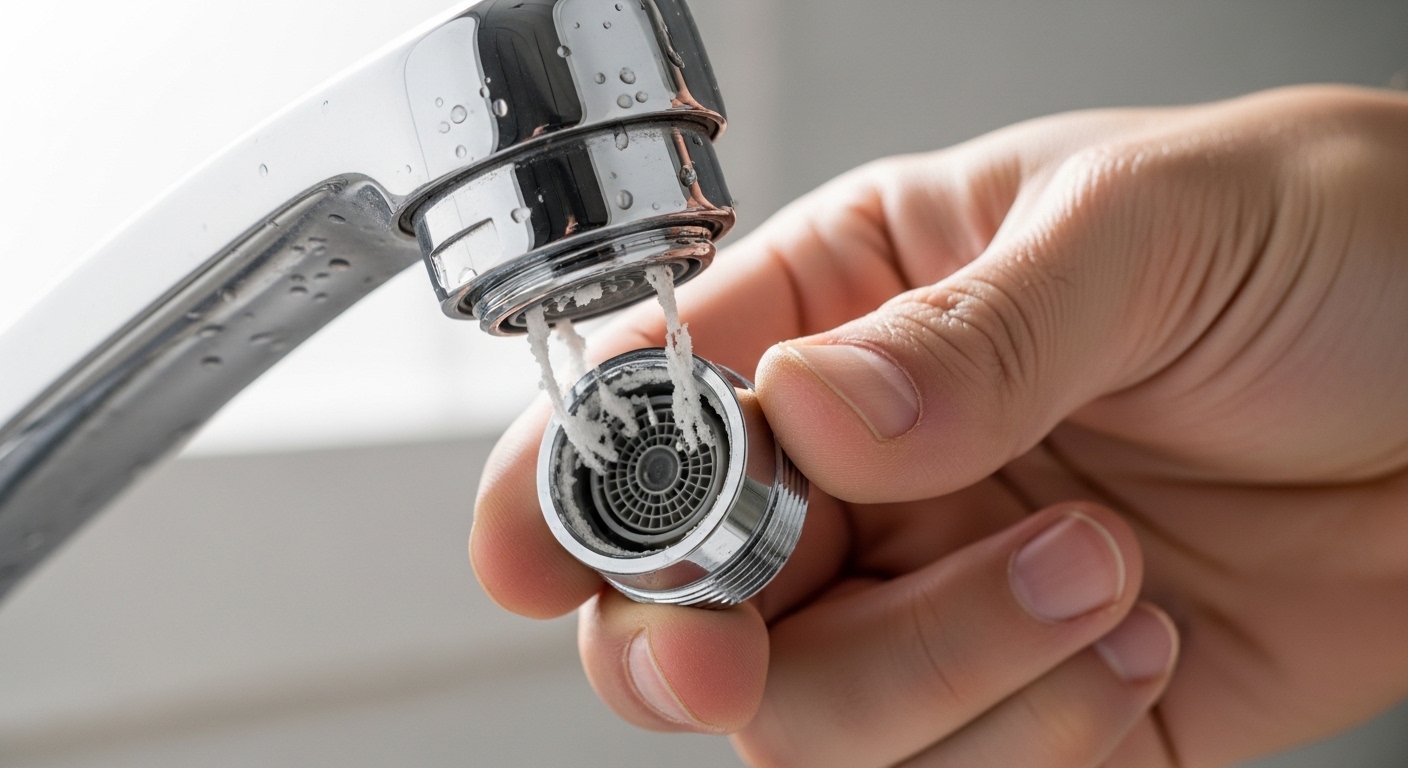
If your kitchen faucet is the only fixture in the house with weak flow, the problem is almost certainly inside the faucet itself — not in your home’s water supply. The most common cause, by a wide margin, is mineral buildup in the aerator (the small mesh screen at the tip of the spout). Hard water leaves behind calcium and magnesium deposits that physically block the tiny holes the water passes through.
To confirm this is your issue, do a simple 10-second test: unscrew the aerator by hand (or with pliers wrapped in a rag), then turn the faucet on. If the water suddenly gushes out at full force, your aerator is the bottleneck. If the flow is still weak with the aerator removed, the problem is deeper — usually the cartridge, supply lines, or shutoff valves.
Other reasons a single faucet loses pressure while the rest of the house is fine:
- Clogged pull-down sprayer head — same mineral problem, different location
- Kinked or pinched supply line under the sink (very common after under-sink storage gets shuffled)
- Partially closed angle stop valve — someone may have bumped it during a recent repair
- Debris in the cartridge after a city water main repair or water heater flush
- Failing cartridge (usually 7+ years old, often combined with handle stiffness)
How do I clean a clogged kitchen faucet aerator step by step?
Unscrew the aerator counterclockwise, soak the parts in undiluted white vinegar for 30 minutes, scrub gently with an old toothbrush, rinse, and reinstall. That’s the entire fix for the vast majority of low-flow kitchen faucets. Here’s the detail that makes the difference between a quick fix and a stripped aerator.
Step 1 — Identify your aerator type. Modern kitchen faucets use one of three aerator styles:
- Standard male/female thread — the visible ring at the tip unscrews directly
- Cache (hidden) aerator — requires a small key tool, usually included in the original faucet box; if you don’t have it, a coin trick or rubber jar opener often works
- Dual-spray pull-down head — the entire spray head unscrews; the aerator screen is inside
Step 2 — Remove without scratching the finish. Always turn by hand first. If it won’t budge, wrap the aerator in a thick cloth or rubber band before using slip-joint pliers. Brushed and matte finishes scratch easily, and we cover this in detail in our guide on how to protect faucet finishes and keep them looking new.
Step 3 — Disassemble fully. An aerator typically has 3–5 parts: the outer housing, a flow restrictor (a small plastic disc with a hole), a rubber gasket, and one or two mesh screens. Lay them out in order on a paper towel so you can reassemble correctly.
Step 4 — Soak in white vinegar. Use undiluted distilled white vinegar at room temperature. 30 minutes is enough for light scale; heavy buildup may need 2–3 hours. Do not use CLR or stronger descalers on plated finishes — they can pit the chrome or brushed nickel.
Step 5 — Scrub and rinse. A soft toothbrush gets into the mesh. Rinse with hot water, holding the screen up to a light — you should see uniform light through every hole.
Step 6 — Reassemble in the correct order. Wrong order = leaks or no improvement. The flow restrictor usually goes first (toward the faucet), then the screen, then the rubber gasket, then the outer ring.
What if cleaning the aerator didn’t fix it — is my cartridge bad?
If flow is still weak after a thorough aerator cleaning, your next suspect is the cartridge — the cylindrical valve inside the faucet body that controls hot, cold, and volume. A failing cartridge usually shows two or three symptoms together: low flow, a stiff or wobbly handle, and sometimes temperature drift (cold creeping into your hot setting).
Before you replace the cartridge, do this diagnostic: turn the faucet on full hot, then full cold, then a mix. If one temperature is dramatically weaker than the other, sediment is trapped inside the cartridge on that side. Sometimes a “flush” fixes this: shut off the angle stops, remove the cartridge, rinse it under running water in both directions, and reinstall.
If flow is uniformly weak across all temperatures and the cartridge looks worn (cracked O-rings, scored ceramic discs, visible scale that won’t rinse off), it’s replacement time. Cartridges are faucet-specific — order by faucet brand and model number, not by appearance. We have a detailed walkthrough on how to identify a faulty kitchen faucet cartridge that covers brand-by-brand identification.
Could it be the supply lines or shutoff valves under my sink?
Yes, and this is the most overlooked cause of sudden low flow. Open the cabinet under your sink and check three things in order:
- Are the angle stop valves fully open? Turn each handle counterclockwise until it stops. If you feel it move even a quarter turn, you found your problem — someone partially closed it.
- Are the supply lines kinked? Braided stainless lines can develop sharp bends that restrict flow by 50–80%. Straighten them gently; if a kink has caused a permanent crease, replace the line ($8–$15 at any hardware store).
- Are the supply lines clogged internally? Rare, but possible after a water heater replacement or main break. Disconnect at the faucet end, point into a bucket, and open the angle stop briefly. You should get a strong, steady stream from both hot and cold.
Old angle stops (those football-shaped chrome valves) can also clog internally with scale. If yours are more than 15 years old and you’ve never replaced them, they’re worth replacing while you’re under there anyway — they fail closed at the worst possible moment.
How do I fix low flow on a pull-down or pull-out sprayer head?
Pull-down sprayer heads get clogged faster than fixed spouts because they have more rubber nozzles exposed to evaporating water — and each one is a tiny scale magnet. The fix is the same vinegar soak, but the process is slightly different.
Unscrew the spray head from the hose (usually a plastic threaded collar — hand tight, no tools needed). You’ll see two flow paths: the aerator stream and the spray pattern. Both need cleaning. Submerge the entire head in a bowl of white vinegar for 1–2 hours, then run water through it backward (from the hose-side opening) to flush loosened debris out the nozzles.
For the rubber spray nozzles, gently rub them with your thumb while the head is wet — most modern sprayers have self-cleaning silicone nubs designed to flex and shed scale when massaged. If individual jets are still blocked after soaking, a sewing pin clears them in seconds without damage.
While you have the sprayer head off, inspect the hose weight (the round counterweight clipped to the hose under the sink). If the weight has slipped down and is resting on the cabinet floor or against the drain pipe, the hose can’t retract smoothly — but that’s a retraction issue, not a flow issue, so don’t blame it for low pressure.
How much water flow should a kitchen faucet actually have?
U.S. federal law caps kitchen faucet flow at 2.2 gallons per minute (GPM) at 60 psi, and California/Colorado/Washington cap it at 1.8 GPM. Anything above ~1.5 GPM feels strong; below 1.0 GPM feels frustratingly weak. If you’ve cleaned everything and you’re still getting a trickle, measure: put a 1-gallon jug under the faucet, run it full blast, and time it. Less than 30 seconds = you’re at or above 2.0 GPM (healthy). 60+ seconds = something is still restricting flow.
Here’s a quick reference for what’s normal vs. what’s a problem:
| Measured Flow | GPM Equivalent | Verdict | Likely Cause if Low |
|---|---|---|---|
| 1 gallon in < 30 sec | 2.0+ GPM | Full flow — no problem | N/A |
| 1 gallon in 30–45 sec | 1.3–2.0 GPM | Normal (eco aerator) | Likely fine |
| 1 gallon in 45–75 sec | 0.8–1.3 GPM | Mild restriction | Clean aerator first |
| 1 gallon in 75–120 sec | 0.5–0.8 GPM | Clear problem | Cartridge or supply line |
| 1 gallon in > 2 min | < 0.5 GPM | Severe blockage | Shutoff valve or main supply |
If your how to fix a low flow kitchen faucet investigation ends with the realization that you’re actually at the legal max flow rate and it just feels weak compared to a friend’s faucet, the issue is your home’s water pressure (measured in psi), not your faucet. A pressure gauge that screws onto an outdoor hose bib costs $12 and tells you instantly — anything below 40 psi at the house means you may need a pressure-boosting solution from your water utility.
Aerator vs cartridge vs supply line: which fix should I try first?
Start with whichever is cheapest and easiest to reverse. Here’s the diagnostic ladder we recommend:
| Fix | Time | Cost | Difficulty | Success Rate for Low Flow |
|---|---|---|---|---|
| Clean aerator | 15 min + 30 min soak | $0 | Very easy | ~70% |
| Clean sprayer head | 10 min + 1 hr soak | $0 | Very easy | ~10% (when applicable) |
| Check/open angle stops | 2 min | $0 | Very easy | ~8% |
| Straighten/replace supply line | 15 min | $0–$15 | Easy | ~5% |
| Flush or replace cartridge | 30–60 min | $15–$60 | Moderate | ~5% |
| Replace angle stop valve | 45 min | $10–$25 | Moderate | ~1% |
| Replace entire faucet | 1–2 hours | $80–$400+ | Moderate | ~1% |
The math is obvious: try the free, 15-minute aerator clean first. We see homeowners online spend $200 on a new faucet only to discover their original was perfect — the new one had the exact same flow rate because the problem was hard water, not the faucet. If you’re noticing scale buildup all over your fixtures, you also want to read our guide on how to tell if a faucet is truly water-saving, because some “low flow” complaints are actually about appropriately water-saving designs.
When should I just replace the faucet instead of fixing it?
Replace the faucet — don’t repair — when any of these are true: the body is corroded or pitted, the spout swivel base leaks even with new O-rings, the cartridge is discontinued and no third-party replacement exists, OR you’ve already replaced the cartridge once before and you’re back to the same problem within 2 years. Repeat cartridge failures usually mean the valve seat inside the brass body is scored, and you can’t fix that without machining.
Also worth replacing: any faucet older than 15 years that doesn’t carry a “lead-free” certification. Pre-2014 brass faucets can legally contain up to 8% lead by weight — modern faucets are capped at 0.25%. We cover this in detail in our guide on how to remove lead from faucets safely, which is essential reading if your home is older.
If you do decide to replace, brand choice matters less than you’d think for flow performance — almost all major brands meet the same 1.8 or 2.2 GPM standard. The real differences are in cartridge quality, finish durability, and warranty. We compared the big three in detail in Moen vs Delta vs Kohler Faucet: Which Brand Should You Actually Buy in 2026?.
How do I prevent low flow from coming back?
Three habits keep flow strong for years instead of months:
- Clean the aerator every 6 months — set a phone reminder. If you live in a hard-water area (most of the U.S. Southwest, Midwest, and Florida), make it every 3 months.
- Install a whole-house water softener or a point-of-use filter if your water hardness is above 10 grains per gallon (gpg). Test strips are $8 and tell you in 30 seconds.
- Flush after any plumbing work. When the city repairs a water main, when your water heater is replaced, or when you’ve done any drain work — remove the aerator and run the faucet for 2 minutes to flush debris before it lodges in the cartridge.
These three habits will extend the life of every faucet, valve, and appliance in your home, not just the kitchen sink. They’re also the cheapest insurance against the more expensive failures down the line, like a stuck cartridge that requires faucet replacement.
FAQ
Why does only my hot water have low pressure in the kitchen?
Sediment from your water heater is the most likely cause. When water heaters age, mineral scale and rust flakes break loose and travel up the hot line. Flush your water heater (drain a few gallons from the bottom valve), clean the hot side of your faucet cartridge, and replace the hot supply line if discoloration is visible. Old galvanized hot water pipes inside the wall can also corrode internally — that’s a bigger job requiring a plumber.
Can a clogged aerator damage my faucet over time?
Not the aerator itself, but the backpressure it creates can stress the cartridge and O-rings, leading to premature wear and small leaks. A clogged aerator also masks a developing problem: you might not notice a cartridge that’s failing because flow already feels weak. Cleaning every 6 months is genuinely preventive maintenance, not just performance tuning.
Is removing the flow restrictor a good idea for stronger flow?
Generally no. Removing the flow restrictor is illegal under the federal Energy Policy Act for new installations, voids most manufacturer warranties, increases your water and water-heating bills by 20–40%, and rarely gives the dramatic improvement people hope for. If your flow feels weak, fix the underlying restriction (scale, cartridge, supply line) rather than removing the part designed to limit flow.
My faucet was strong yesterday and weak today — what changed?
Sudden flow loss usually points to debris, not gradual scale. Common triggers: a city water main repair released sediment into your line, your water heater was recently serviced, or someone bumped an angle stop valve while putting things under the sink. Start by checking the angle stops, then remove and inspect the aerator — you’ll often find a single piece of grit blocking it.
Will a new faucet from a different brand have the same flow rate?
Yes, within 0.2 GPM. All faucets sold in the U.S. must meet the same federal 2.2 GPM cap (1.8 GPM in CA/CO/WA), so swapping brands won’t dramatically change flow. What can change is perceived flow — a wider aerator pattern, a laminar (clear column) flow option, or a pull-down with a stronger spray mode can all feel more powerful even at the same GPM. If you’re shopping, our 5 questions to ask before you buy a faucet covers what to look for.
How long should a kitchen faucet last before flow issues become unfixable?
A quality kitchen faucet should last 15–20 years with basic maintenance. Cartridges typically need replacement every 7–10 years in hard-water areas, every 12–15 in soft-water areas. Finish wear and spout swivel leaks tend to appear first, around year 10–12. If your faucet is in that range and you’re facing your second cartridge replacement, replacement is usually the better economic choice.
Does low flow mean my water bill will go down?
Slightly, but probably not enough to notice. Most kitchen faucet use is task-based (filling a pot, rinsing dishes) — you use the same volume of water regardless of flow rate; it just takes longer. The exception is hand-rinsing dishes under running water, where lower flow does save water. For real water savings, look at hidden leaks, which we cover in our guide on how to detect hidden faucet water waste.
Author note: This guide was written by the iVIGA product engineering team, drawing on a decade of designing, testing, and supporting kitchen and bathroom faucets across U.S. and international markets. iVIGA faucets are tested to NSF/ANSI 61 and 372 standards for drinking water safety and lead content, and are backed by a limited lifetime warranty on the faucet body and a 5-year warranty on cartridges and finishes. For questions specific to your model, our customer service team can be reached through www.ivigafaucet.com.